


Abstract
Purpose
Diet modification is an established first-line compensatory technique for dysphagia management, and thickeners are used to modify liquids. Commercial thickening agents are used to decrease the flow rate of liquids, and allow patients more time to initiate the swallow. Patients do not always like thickened fluids and so compliance can be difficult to achieve. We undertook a study to evaluate the performance of a new xanthan gum-based thickener in terms of dysphagia patient acceptance (like/dislike of overall sensory characteristics), and compliance (amount of fluid consumed vs. amount offered), and gastrointestinal (GI) tolerance (8 symptoms).
Methods
Nursing home residents (n=19, M=74 years) with a known dysphagia participated in an open, observational study for two weeks. A speech and language therapist (SLT) monitored all participants weekly and had prescribed Stage 1, 2, or 3 fluids based on individual needs at the start of the trial. A xanthan gum-based thickener* was used to thicken the variety of liquid bases and temperatures (e.g. coffee, tea, water, milk, oral nutritional supplement) consumed daily.
Result(s)
After consuming the thickened liquids, residents indicated that they ‘liked’ 94% of the drinks. Between 680-900ml of fluid was received daily as thickened liquids. For 86% of the drinks, ¾ or more of the amount offered was consumed; while 67% of drinks were fully consumed. No symptoms of GI intolerance were reported.
Conclusions
- The new xanthan gum-based thickener was liked for its sensory characteristics, one of which is the clearness of the fluids
- It thickened well
- It held its desired thickness with no GI intolerance.
Introduction
Increasing the bolus viscosity of liquids with the use of commercial thickening agents is regularly used as a compensatory strategy for SLTs.1 Increasing the viscosity of fluids using commercial thickening agents decreases the flow rate, allowing patients more time to initiate a swallow and prevent or decrease aspiration during swallowing.2 Clinical practice guidelines of premier associations recommend thickened liquids as part of early and effective management of dysphagia.3
The total fluid intake target for older adults is between 1500ml and 2000ml daily.4 While both foods and liquids normally contribute to a person’s total daily fluid intake, food sources contribute more to daily fluid intakes among elderly with swallowing disorders. A study demonstrated that more than 70% of water consumed with a dysphagia diet was derived from food, including purees served during the day.5 Assuming that 70% of an older adult’s daily fluid intake is from other sources like purees, 30% (or 600ml) of an individual’s daily fluid target would need to come from liquid thickened with commercial thickening agents.
Inadequate fluid intakes and suboptimal compliance are frequently reported among dysphagia patients offered thickened liquids.6 When selecting a thickener, consider its potential to optimize compliance. It is best that the intervention is not associated with iatrogenic effects (eg, symptoms of gastrointestinal (GI) intolerance).7 In addition, product recommendation should be suited to preference criteria for sensory characteristics such as taste, texture, and appearance.8 A diet that includes variety has been demonstrated to encourage oral intakes9; thus, a patient can benefit from a product that supports use in a variety of liquid bases and temperatures.
Objective
The acceptance, compliance, and GI tolerance of a novel xanthan gum-based thickener* was evaluated in nursing home residents who had oropharyngeal dysphagia.
Methods
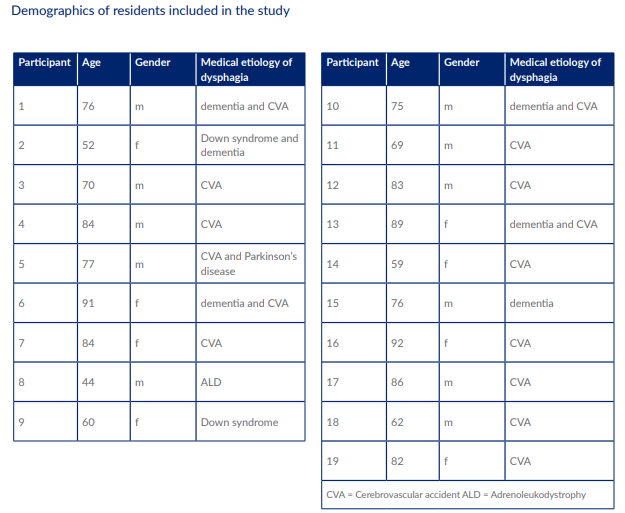
An open, observational study was conducted in line with the standards of the United Kingdom’s Advisory Committee on Borderline Substances [10]. Nineteen residents from a single nursing home centre were recruited according to established inclusion and exclusion criteria (TABLE 1). All residents gave voluntary written consent before participating in the study, and were advised on their right to withdraw from the study at any time. TABLE 2 shows the age (M=74 years), gender, and medical etiology of dysphagia among the nursing home residents included in the study. All participants were under the care of a SLT and received weekly follow-up at minimum. During a 2-week study period, they received intervention with liquids thickened to their prescribed level using a novel, xanthan gum-based thickener*. Nursing and care staff recorded information (type of liquid, level of thickening, resident acceptance [like or dislike], and amount consumed) on a data collection form after each drink was consumed. In addition, data was collected on 8 symptoms of GI intolerance (diarrhoea, constipation, bloating, vomiting, nausea, burping, flatulence, and stomach pain/discomfort) on a daily basis. The amount of drinks consumed per day for each resident was determined by calculating the average daily amount from the total drinks consumed in a week. Due to an incomplete data sheet, information from one participant was omitted from the study results.
TABLE 1.
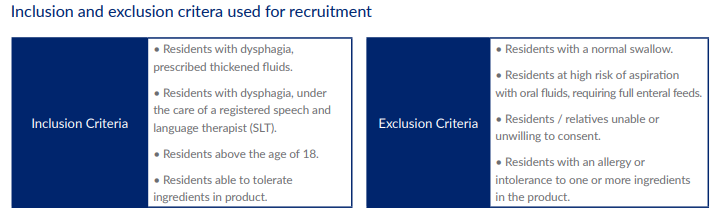
TABLE 2.
Results
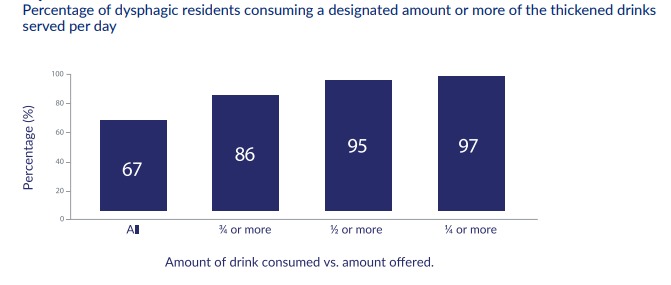
A novel, xanthan gum-based thickener* was used in a variety of liquids and temperatures. Coffee or tea contributed to the majority (63%) of the served drinks. After consuming the thickened liquid, residents indicated that they ́liked ́ 94% of the drinks (FIGURE 1). Between 680-900ml of fluid was received daily as thickened liquids. For 86% of the drinks, ¾ or more of the amount offered was consumed; while 67% of drinks were fully consumed (FIGURE 2). No symptoms of GI intolerance were reported.
FIGURE 1.
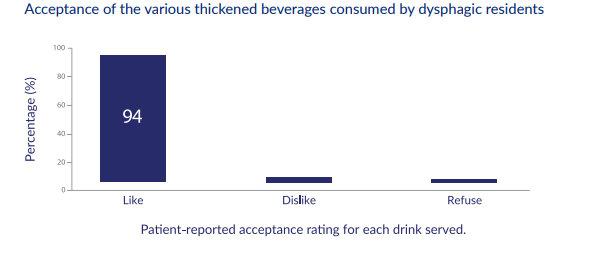
FIGURE 2.
Conclusion
The novel, xanthan gum-based thickener* was suitable for use in a variety of liquids and temperatures. Liquids served at their prescribed level of thickening were well-liked by nursing home residents, and no symptoms of GI intolerance were reported. Good acceptance and compliance was based on sensory characteristics, particularly noted was the clearness of the fluid
Limitations
These results apply to an exclusive xanthan gum-based thickener* specifically manufactured by a patented process that allows for rapid hydration of the xanthan molecules, instantaneous stability, and dissolution without the formation of lumps. The results do not extend to other commercially available xanthan gum-based thickeners. Future studies could compare the acceptability, compliance, and GI tolerance of various commercially available xanthan gum-based thickeners
Disclosure: Product and research support for this study was provided by Nestlé Health Science, Croydon, United Kingdom, or its affiliates.
Acknowledgements: The contributions of the nursing and care staff at MHA Care Group, Coventry, United Kingdom, helped make this research possible.
Presented at the Dysphagia Research Society.
References:
- Garcia et al. Am J Speech Lang Pathol. 2005;14(1):4-13.
- Steele et al. Dysphagia. 2003;18(3):182-95.
- World Gastroenterology Organization. 2007 [cited 2011 Jan 13] Available: http://www.worldgastroenterology.org/assets/downloads/en/pdf/guidelines/08_dysphagia.pdf
- Chidester and Spangler. J Am Diet Assoc. 1997;97(1):23-28.
- Philip and Greenwood. J Am Diet Assoc. 2000;100(5):549-554.
- Macqueen et al. Dysphagia. 2003;18(1):46-52.
- Riedinger and Robbins. Clin Geriatr Med. 1998;14(4):681-698.
- Matta et al. J Am Diet Assoc. 2006;106(7):1049-54.
- Bernstein et al. J Am Diet Assoc. 2002;102(8):1096-1104.
- Advisory Committee on Borderline Substances. 2009 [cited 2011 Jan 13] Available: http://www.cmu.nhs.uk/Pages/ACBS.aspx
Purpose Diet modification is an established first-line compensatory technique for dysphagia management, and thickeners are used to modify liquids. Commercial thickening agents are used to decrease the flow rate of liquids, and allow patients more time to initiate the swallow. Patients do not always like thickened fluids and so compliance can be difficult to achieve. We unde...


