


Introduction
For people with dysphagia, it is commonly recommended for fluids to be thickened in order to assist with bolus control and help reduce the risk of choking and aspiration.1-4 However, it has been found that many patients report a dislike of thickened fluids, especially thicker consistencies, thus reducing their quality of life and increasing their risk of dehydration from reduced fluid intake.1,3,5,6 Payne et al (2011) argue that the reason for patients with dysphagia remaining dehydrated, especially when using thickening agents to modify their drinks, is most likely due to the altered organoleptic characteristics of the drinks as a result of the thickening agents used. Indeed, studies have shown commercially available starch-based thickeners have an undesirable ‘starchy’ flavour, are grainy in texture, and cause lumping when mixed with fluids.7,8 This is despite the Francis report (Francis 2013) stating that individuals are to have access to food and drink that is palatable and in a suitable form for consumption.7 Therefore, as Schiwitz and Smith (2016) state in their discussion, finding ways of making thickened fluids more acceptable to patients has the potential to improve their overall health outcomes, and is clearly of utmost importance.
In recent years, newer gum-based thickening products have entered the commercial market. Unlike their starch-based counterparts, drinks mixed with these thickeners have been shown to look and taste better and to maintain their texture more effectively over time, across temperatures and types of drink, and when mixed with saliva due to improved amylase-resistant properties.5,9-12 Based on this evidence, Mills (2008) encourages institutions to move away from starch-based products and instead consider the use of newer gum-based thickeners, to help maximise the opportunities for patients to meet their hydration needs.12
Background
Colchester General Hospital currently use a common commercially available starch-based thickening product across the hospital for all inpatients. However, the recent evidence base, outlined above, was one motivating factor for the adult acute speech and language therapy team to begin investigating the process of changing to a gum-based product. A further driving force was the aim of making the patients’ journey smoother, from inpatient through to community follow up.
Our colleagues in the adult acute and learning disability community speech and language therapy teams currently use a gum-based thickening agent. Therefore the team decided to conduct some research within the hospital first, into opinions of the different products available before directly approaching companies to enquire about the specific packages they could offer if we were to change to their products.
Aim
Previous published research has compared different thickeners and investigated individual preferences through the use of blind taste testing.13-15 In a similar way, the team also decided to conduct a blind taste test of the common thickening agents available on the market. The aim was to gather and compare opinions from different professionals within the multi-disciplinary team (MDT) working with patients with dysphagia, without participants being influenced by any previous thoughts or longstanding preferences or perceptions of brands. By collecting and analysing this data, the team then hoped to use this to help inform their decision making and future selection of a new thickening agent for the hospital.
Method
Four different thickening agents were mixed with three different drinks in line with the instructions on their respective labels. The thickening agents included:
- One starch-based thickener which the hospital was using at the time of the taste test
- Three different gum-based thickeners including Resource® ThickenUp™ Clear
They were each mixed to Stage 1 (syrup consistency) with water and tea, and to Stage 2 (custard consistency) with orange squash. Thus in total there were twelve different drinks to test. All participants were blinded to the brand of the thickener used in each drink.
The tasting session was conducted during an afternoon on the hospital’s stroke unit. All members of the speech and language therapy team, and any professional from the stroke unit MDT were invited to take part. Participants provided qualitative data by documenting any thoughts and reflections about the drinks they tasted, and quantitative data by ranking the thickeners by order of preference and selecting one as their final favourite.
Results
Surveys were completed by 19 participants:
- 10 speech and language therapists
- 9 members of the wider MDT
Quantitative data
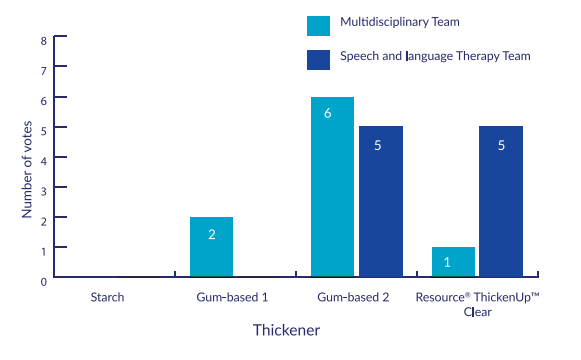
As can been seen from the graph below, within the speech and language therapy team, members were split equally between preferring Resource® ThickenUp™ Clear and one other gum-based thickener. Data from the wider MDT however, revealed a preference for this second gum-based product.
Graph 1: Results of blind taste testing
Qualitative data
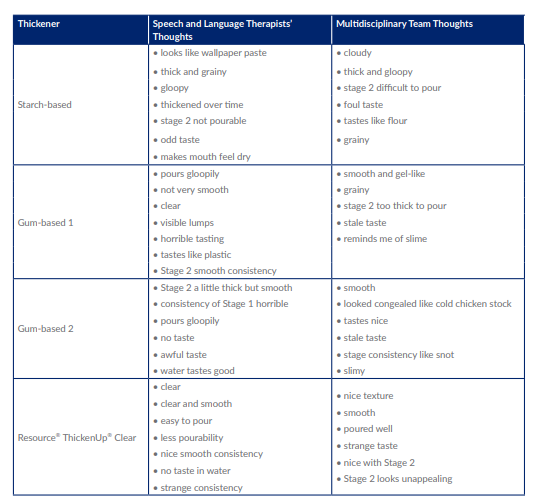
Participants were asked to provide written detail summarising their thoughts about the drinks they tasted. Suggestions offered for consideration were appearance, smell, texture, taste, ‘pourability’, and how they were in line with the thickening stages (syrup, custard etc.). Below are some of the quotes given about how the beverages tasted.
Table 1: Participants’ quotes from blind taste testing
Discussion
Following the blind tasting session, the speech and language therapy team met to discuss the results and our next steps. It was interesting to see the difference in voting behaviour between the speech and language therapists and the MDT, and look at this alongside participants’ written thoughts and opinions. As can be seen in the table above, both the starch-based and first gum-based thickeners had an overriding negative reaction. However, for both the second gum-based product and Resource® ThickenUp™ Clear there seemed to be quite a varied and mixed opinion base. We decided to approach the companies of both the second gum-based thickener and Resource® ThickenUp™ Clear for further information about their products.
A representative from each company came to meet with our team on two different occasions. Following these meetings, the team once again discussed which product we would prefer to choose to take forward as the proposed change from our current starch-based thickener. We felt that the package that Resource® ThickenUp™ Clear were prepared to offer was superior to that of the second gum-based product. This comprehensive package included support in creating and delivering training across the hospital, which was an initial concern given the difference in mixing methods between the thickeners. Their representative also reassured us that there would be somebody available to assist with any queries or difficulties that might arise, throughout the planning and implementation of the product switch and afterwards too.
A further important factor to consider was the product our patients were being prescribed outside of the acute hospital environment. As previously mentioned, this was one of the original motivations for looking into changing our product. Our patients were using a starch-based thickener during acute hospital stays, and if referred for further speech and language therapy in the community, they would then be prescribed Resource® ThickenUp™ Clear by the community team who were already using this product. Further confusion was also caused for patients already being seen by a speech and language therapist in the community - they were using Resource® ThickenUp™ Clear in the community, then using a starch-based thickener when in hospital, and then continuing to use this thickener once discharged until review again from the community team to revert back to their previous product. As a team of healthcare professionals it is of the upmost importance that our patients’ healthcare journey and experience with the professionals treating them is smooth, seamless and without worry.
This aim, combined with positive reviews on the blind-tasting session and an all-round superior and complete package that could be offered from the company, were the reasons the team decided to choose Resource® ThickenUp™ Clear as the new thickening agent.
Reflections and points for other teams to consider for similar projects
After conducting this blind tasting session, I was able to reflect on what went well and what could be improved if it was to be repeated.
I considered the benefits of gathering data from a larger sample of participants. This would provide more voting behaviours and descriptive thoughts on the products to compare and contrast. However, although more data would be useful to inform and guide our decision-making, as a small team with a busy case load to prioritise and manage on a daily basis outside of this project, further data gathering would require extra time to analyse and summarise and would take too much time away from our clinical priorities. It was therefore important for us to gather all the opinions of the speech and language therapy team, and gain the ‘snapshot’ view of the wider hospital MDT which provided us with useful extra insights and views on the products.
I also believe data from patients themselves would be useful to provide a further dimension to the views gathered from professionals. Some of my speech and language colleagues have started collecting information from their stroke unit patients with regards to their preference when blind tasting our starch-based thickener and Resource® ThickenUp™ Clear. If we had done more taste testing with our patients during the decision making process, this information would certainly have added to what was gathered from the professionals as a patient’s perspective is vitally important when providing patient-centred care
One further consideration that I believe should be taken into account is good preparation during the taste testing. As the main organiser of the tasting event, I recognised the need to ensure plenty of preparation time when making several drinks of different consistencies with different thickeners. Trying to ensure everything was ready for participants on time meant that some preparation may have been rushed, even though I still had two colleagues assisting me. This may have caused variations across and within the same drinks, consistencies and products used, potentially one reason for the varying opinions of the same products as seen in the table above. Therefore, ensuring there is adequate time to consistently prepare all of the drinks in line with label directions is important for the ultimate results and the decision-making which follows.
Final comment
Following team discussions, the Adult Acquired Speech and Language Therapy team at Colchester General Hospital have decided to change their thickening product from starch-based to Resource® ThickenUp™ Clear. Using a blind taste testing session with different hospital professionals before directly approaching companies was highly useful and informative and helped support our decision making. With this decision made, we will now continue to liaise with Nestlé Health Science, to put together a plan for implementing this change across the hospital.
References
- Schiwitz A & Smith A (2016) ‘Shaken and stirred’ RCSLT Bulletin 17-18 Online at: http://www.rcslt.org/docs/bulletin/2016/mar_2016 [Accessed on: 25th March 2016].
- Cichero J (2013) ‘Thickening agents used for dysphagia management: effect on bioavailability of water, medication and feelings of safety’ Nutrition Journal 12 (54) Online at: http://www.ncbi.nlm.nih.gov/pmc/articles/PMC3660277/ [Accessed on: 25th March 2016].
- Payne C, Methven L, Fairfield C & Bell A (2011) ‘Consistently inconsistent: Commercially available starch-based dysphagia products’ Dysphagia 26 27-33.
- Castellanos VH, Butler E, Gluch L & Burke B (2004) ‘Use of thickened liquids in skilled nursing facilities’ Journal of the American Dietetic Association 104 (8) 1222–1226.
- Garcia J, Chambers E & Molander M (2005) ‘Thickened liquids: practice patterns of speech-language pathologists’ American Journal of Speech-Language Pathology 14 4-13.
- Whelan, K (2001) ‘Inadequate fluid intakes in dysphagic acute stroke’ Clinical Nutrition, 20 (5), 423-428.
- Francis R (2013) Report of the Mid Staffordshire NHS Foundation Trust Public Inquiry. http:// webarchive.nationalarchives.gov.uk/20150407084003/http://www.midstaffspublicinquiry. com/sites/default/files/report/Volume%203.pdf [Accessed on: 25th March 2016].
- Matta Z, Chambers E, Garcia JM & McGowan Helverson J (2006) ‘Sensory characteristics of beverages prepared with commercial thickeners used for dysphagia diets’ Journal of the American Dietetic Association 106 (7) 1049-1054.
- Lotong V, Chun SS, Chambers E & Garcia JM (2003) ‘Texture and flavor characteristics of beverages containing commercial thickening agents for dysphagia diets’ Journal of Food Science 68 (4) 1537–1541.
- Penney B (2014) ‘Use of fluid thickener to reduce dysphagia risk’ Nursing Times 110 (12) 16-18. Online at:http://www.nursingtimes.net/download?ac=1278186 [Accessed on: 25th March 2016].
- Vallons K, Helmens H & Oudhuis A (2014) ‘Effect of human saliva on the consistency of thickened drinks for individuals with dysphagia’ International Journal of Language and Communication Disorders 50 (2) 165-175.
- Mills RH (2008) ‘Dysphagia Management: Using thickened liquids’ The ASHA Leader 13 (14) 12-13.
- Macqueen CE, Taubert S, Cotter D, Stevens S & Frost GS (2003) ‘Which commercial thickening agent do patients prefer?’ Dysphagia 18 46-52.
- Pulver D, Williams R, Johnson C, Smith S, Patrick J, Heggie L & Bentley D (1999) ‘Thickened drinks: Spit or swallow?’ RCSLT Bulletin 12–13.
- Pelletier CA (1997) ‘A comparison of consistency and taste of five commercial thickeners’ Dysphagia 12 74-78.
For people with dysphagia, it is commonly recommended for fluids to be thickened in order to assist with bolus control and help reduce the risk of choking and aspiration.1-4 However, it has been found that many patients report a dislike of thickened fluids, especially thicker consistencies, thus reducing their quality of life and increasing their risk of dehydration from..


