


Synopsis.
A patient with complex feeding issues could not gain weight or reduce the episodes of vomiting, despite trying numerous feeds, until Peptamen® Junior Advance was initiated. Thereafter, his symptoms improved and his family reported improvements in his daily quality of life.
Introduction.
Patient X is a 4 year old boy who is exclusively gastrostomy fed. He has been under the care of paediatric dietitians at County Durham and Darlington Foundation Trust since his birth. He has a history of poor feed tolerance, faltering growth and a complex medical history.
Patient’s medical history.
- Pontocerebellar hypoplasia, a degenerative disorder.
- Low ferritin levels.
- Poor feed tolerance (delayed gastric emptying and vomiting).
- Faltering growth.
Patient X was born at 40 weeks gestation with a birth weight of 4.01kg (75th to 91st centile). His delivery was uncomplicated and spontaneous breathing was established within seconds of birth. Following his discharge, the health visitor noted that he was not meeting certain developmental milestones and therefore referred the patient to a paediatrician.
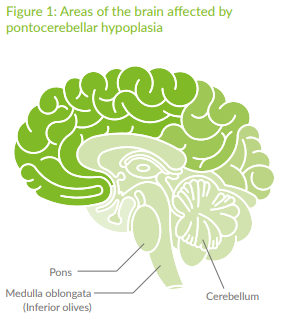
Following the paediatrician’s review, an MRI scan confirmed the presence of pontocerebellar hypoplasia, a degenerative disorder that affects neurons in specific areas of the brain, namely the cerebellum, pons and inferior olives.1
The parents were subsequently referred for genetic counselling. It was felt that the patient had the most common mutation, featured as:
- Dyskinesia.
- Dystonia.
- Feeding difficulties.
- Progressive microcephaly.
- Visual impairment.
He was also diagnosed with dyskinetic cerebral palsy with episodes of increased spasticity, which was treated with Baclofen (a muscle relaxant). The patient remained bottle–fed (standard infant formula) from birth and was weaned from 6 months of age. His food texture progression was slow and lumps were poorly tolerated, often resulting in gagging.
Nutritional requirements and intake.
The majority of his energy requirements were derived from cows’ milk, he was taking 3 x 10oz bottles (900ml) a day which provided: 600kcal and 29.7g protein. In addition to this, he was tolerating 2 x 250g servings of a pureéd diet a day which provided approximately 350kcal and 12g protein. His total intake was 950kcal and 41.7g protein (99kcal/kg compared with EAR of 95kcal/kg).
It was reported that his bottle feeds could take up to 30 minutes, with solids taking up to 45 minutes to consume.
Despite recommendations regarding high calorie weaning products and food fortification, expected weight gain was not achieved. Due to continuing concerns regarding weight loss and faltering growth, oral nutritional supplements (1.5kcal/ml Fortini®) were commenced, which provided an additional 300kcal and 6.8g protein in 200ml. Iron supplementation was commenced due to low ferritin levels.
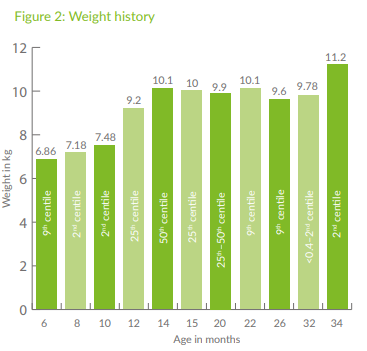
Initially, oral nutritional supplements elicited weight gain and catch up growth, and at 34 months of age his weight had risen to the 2nd centile.
Despite weight gain, feeding continued to be difficult. Mealtimes were extended in length and the patient tired quickly during feeding, which often led to choking and coughing. There was also a history of repeated chest infections over the previous 12 months, which had been treated with antibiotics.
In October 2014 the patient underwent a videofluoroscopy, which indicated that he was at a significant risk of aspiration on all fluids and solids. The radiographer also identified the presence of intra-oesophageal reflux. Sadly, the patient was unable to tolerate nasogastric feeding and the feeding tube was frequently dislodged, with placement becoming increasingly traumatic. Ultimately enteral tube feeding had to be delayed until a gastrostomy tube was placed.
In the following month a gastrostomy tube was placed and the patient was subsequently commenced on a standard polymeric paediatric feed (Nutrini® Nutricia), aiming for: 4 x 250ml (1000kcal, 28g protein). The feeds were run over 60 minutes via a pump and were evenly spaced throughout the day to allow adequate time for digestion. The patient demonstrated poor feed tolerance and would frequently vomit during enteral feeding. The maximum volumes tolerated were in the region of 160-170ml per bolus.
For this reason he was commenced on Nutrini® Energy (Nutricia) which provided 1.5kcal per ml as it was thought that he may be suffering from volume sensitivity. A revised feeding regimen incorporating 4 x 170ml of Nutrini® Energy feeds was given.
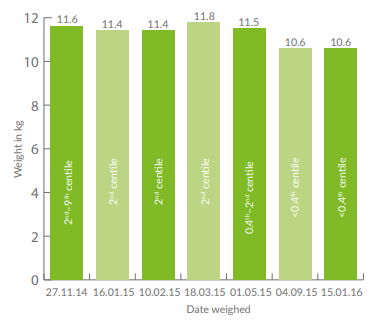
By January 2015, his weight was recorded as 11.4kg (static weight) and vomiting episodes were a frequent occurrence throughout the day. The patient was swapped back to standard Nutrini® as it was felt that the calorie density of an energy feed may be exacerbating feed intolerance. Furthermore, his parents reported that he had appeared more settled on a standard Nutrini® formula.
Figure 3: Weight history following the gastronomy placement when enteral feeds were introduced
The feed volumes were also reduced to a total of 5 feeds of 170ml of Nutrini® (850kcal and 23.8g protein). In order to ensure a steady delivery rate his feeds were administered via a feeding pump over a period of 60 minutes.
By May 2015 it was evident that his weight was dropping, and his parents reported a pattern of vomiting of up to 30 minutes post feeds. This was likely due to delayed gastric emptying. It was recommended that the parents ensured he remained in a 90 degree upright position (bee chair) during and for up to 30 minutes following feeding, to reduce the likelihood of vomiting episodes.
Gaviscon® was also prescribed post feeding. A further therapeutic dose of iron supplementation was deemed necessary to treat the low ferritin levels.
Calogen® (3 x 10ml), a high calorie fat based modular supplement, was given to encourage weight gain. Despite the fact that the mum reported this change was tolerated, intermittent episodes of vomiting continued.
In September 2015 following a review by the paediatrician, a dose of 10mg of omeprazole MUPS was initiated to minimise the risk of further bouts of vomiting. The dose was subsequently maximised to 20mg a day. Despite this intervention feeding intolerance persisted to such an extent that he was referred to the surgical paediatric consultant for consideration of a fundoplication and a possible jejunal extension for feeding.
His parents remained reluctant to proceed with either procedure as fundoplication carries a risk of gagging and retching.2 Additionally, if jejunal feeding was implemented this would necessitate continuous feeding via a pump, which would ultimately affect quality of life, making daily activities such as school, bathing and physiotherapy sessions more difficult.
His parents continued with the previous feeding regimen of 5 x 170ml Nutrini® feeds with 3 x 10ml Calogen® boluses in between. This regimen provided a total of 985kcal and 23.8g protein. By September 2015, the patient’s weight was at its lowest recorded level since the gastrostomy tube placement.
The ongoing concerns were:
- Gagging, retching and vomiting.
- The parents were only able to administer a maximum of 4 bolus feeds of Nutrini® a day (680kcal and 19g protein).
- Pump feeds often had to be halted mid-way through to prevent overt vomiting.
- Feeding rates were decreased so that bolus feeds were administered over 90-120 minutes instead of the previous 60 minutes.
- Continuous feeding via a pump was an option although the parents remained reluctant.
- His nutritional losses in the form of vomiting and interrupted feeding schedule had resulted in static growth.
- A blood test revealed low total protein status, which may have reflected a negative energy balance and subsequent lean body mass breakdown.
At this stage the decision was made to trial a whey–based peptide feed (Peptamen® Junior Advance 1.5kcal/ml), to try to improve feed tolerance. It is widely acknowledged that whey–based formulas can help to promote gastric emptying and hopefully the patient would begin to demonstrate a positive energy balance resulting in weight gain.3
The parents were reluctant to change the feed again and therefore the new feeding regimen was only commenced in April 2016.

The patient tolerated the new regimen of 4 bolus feeds of 160ml of Peptamen® Junior Advance which provided 960kcal and 28.8g protein. There have been no overt episodes of vomiting since commencing Peptamen® Junior Advance and incidents of gagging have been significantly reduced. Feeds were run via a pump over 60 minutes and the parents were able to schedule other daily activities around feeds with no problems.
Conclusion.
Patient X was a child with complex neurodisabilities and associated gastro-intestinal disorders such as reflux and delayed gastric emptying.4
These gastro-intestinal motility disorders contributed to a pattern of poor feed tolerance and faltering growth which impacted significantly on both the patient’s and the parents’ quality of life. Despite several medical and nutritional interventions (such as anti-reflux medication and trial of a reduced volume, high calorie feed and a reduction in pump rate), symptoms of poor feed tolerance persisted.
A 1.5kcal/ml whey based peptide feed resulted in significantly improved feed tolerance and weight gain.
Consideration should be given to the use of whey–based peptide formulas when trying to improve feed tolerance in children with complex neurodisabilites who are tube fed.
References.
1. Pontocerebellar Hypoplasia; Rudkin-Shoneborn et al 2014, online: http://onlinelibrary.wiley.com/wol1/ doi/10.1002/ajmg.c.31403/full.
2. O’Loughlin EV, et al. Antireflux surgery in children with neurological impairment: caregiver perceptions and complications. J Pediatr Gastroenterol Nutr. 2013; 56:46-50.
3. Fried MD, Khoshoo V, Secker DJ, Gilday DL, Ash JM, Pencharz PB. Decrease in gastric emptying time and episodes of regurgitation in children with spastic quadriplegia fed a whey-based formula. J Pediatr 1992;120:569-72.
4. Functional and GI Motility Disorders: Specific Clinical Contexts - Part 3: The Child with Neurodevelopmental Delay: Carvalho and Di Lorenzo 2014: Available (online): https:// www.karger.com/Article/Pdf/356993.
Nestlé Health Science produces a range of foods for special medical purposes for use under medical supervision used with patients requiring either an oral nutritional supplement or a sole source of nutrition. ®Reg. Trademark of Société des Produits Nestlé S.A.
A patient with complex feeding issues could not gain weight or reduce the episodes of vomiting, despite trying numerous feeds, until Peptamen® Junior Advance was initiated. Thereafter, his symptoms improved and his family reported improvements in his daily quality of life. Introduction. Patient X is a 4 year old boy who is exclusively gastrostomy fed. He has been under th...


